
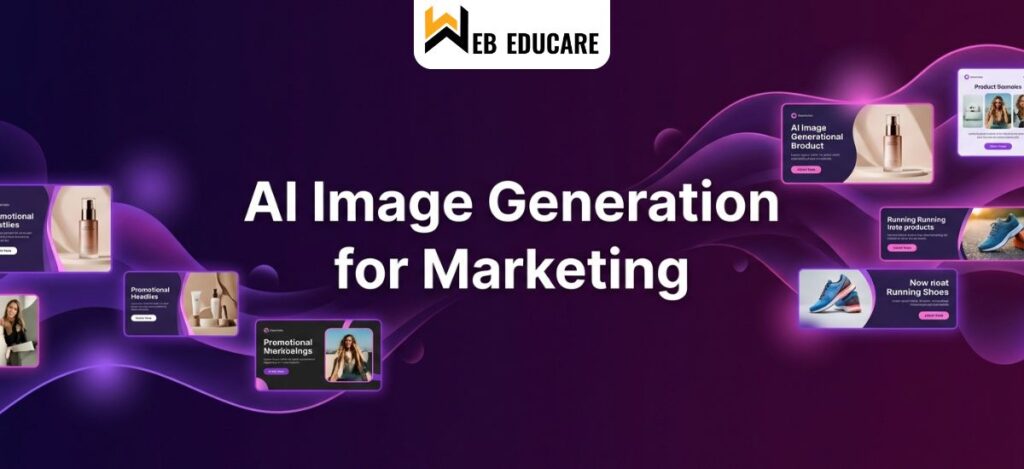
AI Image Generation for Marketing
Artificial intelligence has transformed creative workflows. Generative models now create photorealistic visuals, stylized artwork, and brand assets from simple text prompts — and marketers are already using that capability to scale creative production, personalize messaging, and speed up A/B testing. AI image generation uses large generative models to produce images from text prompts, sketches, or source photos. Modern tools — from commercial platforms like Adobe Firefly, Midjourney and DALL·E to open-source engines — let marketers create everything from hero banners and social posts to ad variants and mockups in minutes. These tools are increasingly integrated into creative suites and marketing stacks, enabling faster ideation and iteration. The AI image generation for marketing is getting constantly popular worldwide.
Read Further Blog: Automated Social Media Marketing
Impact on Marketing Strategies
AI image generation is shifting how teams think about creative scale and experimentation.
Faster Creative Production
Teams can produce dozens of ad visuals for testing in the time it once took to design one.
Personalization at Scale
Marketers can generate localized or person specific images (product in a local setting, culturally relevant scenes) without expensive photoshoots.
Lowered Costs
Early-stage concepts and storyboards are cheaper and quicker to produce, accelerating campaign planning.
New Creative Formats
Image-to-image and multimodal pipelines enable dynamic assets — e.g., static images that become short animated assets or AR-ready visuals.
Adoption of AI across business functions has surged: industry surveys report a large majority of firms using AI in at least one function, reflecting faster uptake of generative tools in marketing teams.
Benefits of Using AI Generated Images
Speed & Scale
Rapidly generate variants for A/B and multivariate testing.
Cost Efficiency
Reduce dependency on frequent photoshoots for routine assets.
Creative Exploration
Test unconventional visual directions at low cost.
Accessibility
Small teams or solo marketers can produce polished visuals without expensive design resources.
Brand consistency: With prompt engineering and model fine-tuning, you can produce on-brand visuals programmatically (templates, color palettes, consistent character styles).
Marketers who experiment with AI report measurable improvements in campaign velocity and creative quantity with early-adopters seeing improved conversion testing throughput.
Current Trends and Future Prospects
Tool consolidation & specialization
Platforms now offer integrated pipelines (image → edit → animate) aimed at marketing workflows; enterprise tiers include brand-safe models and APIs. Popular builders in 2025–2026 include Adobe Firefly, Midjourney, DALL·E and newer specialized suites for commerce and avatar generation. These tools are making AI image generation for marketing very popular for the marketers.
Model fine-tuning for brand identity
More brands train or license models that reflect their photography style and product catalog for consistent visuals at scale.
Regulation and labeling
Governments in Europe and elsewhere are pushing rules that require labeling AI-generated content and protecting individuals from unauthorized deepfakes — meaning compliance and provenance tracking will be part of production workflows. Spain and several European jurisdictions have already moved toward strict labeling and penalties for undisclosed AI content.
Ethical & safety tooling
Expect more automated filters (for likeness, minors, hate symbols, etc.), watermarking/provenance metadata, and enterprise content governance features.
Best Practices
Define use cases first. Decide whether AI is for quick mockups, ad variants, product images, or creative ideation. Different use cases need different tool capabilities (resolution, commercial license, API access).Start with guidelines & a prompt library. Create a repository of prompts, brand tokens (colors, mood, hero product shots), and constraints to ensure consistency. Always route AI outputs through design or brand review for composition, copy overlay, and legal checks.
Version & store assets with metadata. Save prompt + model + seed + license info in your DAM for traceability and future audits. Test on KPIs, not aesthetics alone. Run the AI-generated variants through the same performance tests (CTR, conversion, engagement) as human-created assets. Invest in training & tooling. Give designers time to learn prompt engineering and equip developers to integrate APIs for automation. Monitor cost vs. benefit. Free tiers are great for exploration, but paid/enterprise plans unlock licensing and higher output quality necessary for campaigns. These practices are making AI image generation for marketing very popular for the marketers.
Ethical Considerations and Challenges
Using AI images responsibly is non-negotiable.
Copyright & IP
Clarify model training data and obtain rights for commercial use. The legal landscape is evolving; preserve provenance and licensing records.
Deepfakes & likeness misuse
Avoid generating realistic images of identifiable people without consent; implement safeguards for celebrity and private-person likenesses. Several countries are enacting laws that criminalize or fine undisclosed synthetic content.
Bias & representation
Validate datasets and outputs to avoid stereotyping or exclusion; include diverse reviewers in your creative QA.
Transparency
Where regulation or trust demands it, label synthetic content and publish a clear AI-content policy for your audience.
Safety tools
Use vendor filters, provenance metadata, and content monitoring to reduce misuse risk. Research and policy reports emphasize these priorities as core to scaling generative AI responsibly.
Conclusion and Future Outlook
AI image generation is no longer experimental — it’s a practical lever to speed creative workflows, enable personalization, and expand testing capability. In 2026, the winners will be teams that combine strategic use cases, disciplined governance, and human oversight. Adopt iteratively: pilot, measure impact, scale what moves KPIs — while keeping ethical and legal safeguards front and center. The process is extremely critical. It is better to connect with a digital marketing agency like Web Educare for AI image generation for marketing.